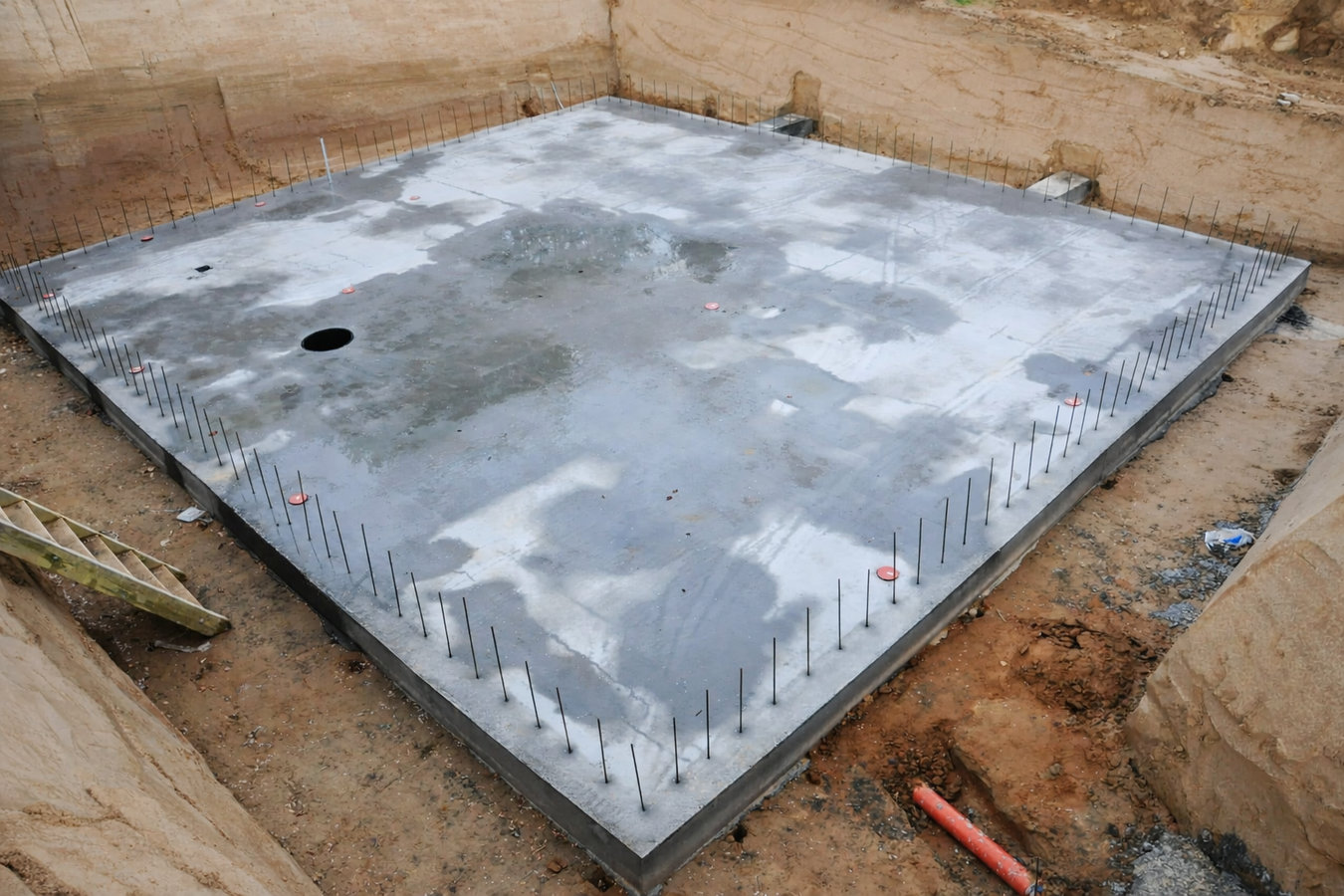
Your foundation is the most important part of your home. We install concrete foundations built for Hobbs clay soil, desert heat, and Permian Basin conditions - with proper reinforcement, vapor barriers, and every city permit handled before a truck arrives.
Foundation installation in Hobbs, NM involves grading and compacting the soil, setting up forms, laying a gravel base for drainage, placing steel reinforcing bars throughout the area, and pouring a concrete slab that will carry the full weight of your home for decades. A typical residential foundation takes two to five days for the pour and site work, with about 28 days of curing time before heavy construction can continue on top of it.
In Hobbs and across southeastern New Mexico, nearly all new homes are built on slab-on-grade foundations - a single poured concrete pad that sits directly on the ground. This approach is well-suited to the region's flat terrain and dry climate, and local contractors have installed hundreds of them in similar soil and weather conditions. Getting the base preparation right is what separates a foundation that holds up for 50 years from one that starts cracking within a decade. If your project also needs support at specific load points along the perimeter, slab foundation building covers the integrated design of the full pad, including thickened edges where wall loads concentrate.
We respond to every inquiry within one business day. A site visit takes 30 to 60 minutes and ends with a written estimate that breaks down every cost before any ground is broken.
The most straightforward reason to call is having a structure that needs a base. Whether you are building a new home from scratch, adding a room, or putting up a detached garage, the foundation has to come first. No framing, plumbing, or electrical work can begin until the slab is poured and cured.
When the ground shifts - which happens regularly in Hobbs due to the clay-heavy soil expanding and contracting with seasonal moisture changes - the frame of your home can move slightly out of square. If doors that used to close easily now stick or drag, or if you see gaps forming at the corners of window frames, the foundation may have shifted and a contractor should take a look.
Small hairline cracks in a concrete slab are common and usually harmless. But cracks wider than a pencil tip, cracks that run diagonally from the corners of doors or windows, or cracks that appear to be growing over time are a sign the foundation may be moving in ways it should not. In Hobbs, the dry-wet soil cycle is a common driver of this kind of movement.
Hobbs does not get a lot of rain, but when summer storms roll through, water that has nowhere to go can sit against your foundation. Over time, that moisture softens the soil beneath the slab and accelerates the shrink-swell cycle. If water collects against your exterior walls after a storm rather than draining away, the grading around your foundation needs attention.
We install concrete foundations for new residential construction, additions, garages, and detached structures throughout Hobbs and the surrounding area. Every project starts with a site visit - we assess the soil conditions specific to your lot, evaluate drainage, confirm dimensions, and design the slab thickness and reinforcement layout to suit what your ground actually requires. We do not use one-size-fits-all specs. The clay-heavy soil in Hobbs calls for proper compaction, a gravel drainage layer, and reinforcement designed to handle the shrink-swell movement that is common in Lea County. For projects where the perimeter needs additional structural depth below the slab, concrete parking lot building shares the same base preparation and reinforcement standards we apply to larger commercial pads in the area.
We handle New Mexico building permits before any work begins and coordinate the required inspections so the city can verify reinforcement and site prep before concrete is placed. Summer pours are scheduled for early morning to protect fresh concrete from Hobbs afternoon heat, and curing measures are applied during the critical first days to protect the long-term strength of the slab. You receive a written contract with a detailed scope of work before anything starts - including the gravel base, vapor barrier, reinforcement, permit fees, and pour details - so you know exactly what you are getting.
Suits homeowners building a new residence on a lot - full site assessment, soil prep, reinforced slab pour, vapor barrier, and permit handling included.
Suits homeowners adding living space to an existing home - new foundation poured to integrate cleanly with the current slab height and drainage layout.
Suits homeowners adding a detached garage, workshop, or storage building - same reinforcement and preparation standards as a residential slab, sized for the structure.
Suits homeowners whose structure requires heavier load-bearing at the perimeter - slab edges are thickened or footings are poured to carry wall and beam loads down to stable soil.
Hobbs sits in the Chihuahuan Desert on the southeastern edge of New Mexico, and the conditions here shape foundation work in ways that a contractor from outside the region often does not anticipate. The soil contains significant clay content that swells with moisture and shrinks in dry periods - and Hobbs is dry most of the year, with annual rainfall typically under 12 inches. That constant shrink-swell cycle is one of the leading causes of foundation cracking in this area, and it means site preparation is not a shortcut that can be skipped. The Portland Cement Association publishes guidance on slab-on-grade construction that any qualified contractor working in expansive soil conditions should be following.
Hobbs is also in the heart of the Permian Basin, where heavy oilfield truck traffic on nearby roads can cause low-level ground vibration over time. For most residential properties this is not a major concern when the foundation is properly built - but it is a real reason to hire a contractor who has worked in this area and understands local conditions rather than one who quotes over the phone from a spreadsheet. Homeowners in Jal and Carlsbad face similar soil and oilfield-proximity conditions, and we bring the same careful approach to foundation work across the region.
We respond within one business day. We will ask a few basic questions - the size of the structure, whether it is new construction or an addition, and the property address. From there, we schedule a site visit, because no accurate quote is possible without seeing the ground in person.
After the site visit, you receive a written estimate that breaks down every cost - labor, materials, site preparation, gravel base, reinforcement, and permit fees. Once you sign, we submit the permit application. Permit approval typically takes a few days to two weeks depending on the workload at the permitting office.
The crew grades and compacts the soil, sets up forms, lays the gravel base, and installs steel reinforcement and a vapor barrier inside the form. A building inspector visits before any concrete is poured to verify this hidden work meets required standards. This step usually takes one to two days.
Pour day starts early in summer to beat the heat. Concrete is placed, leveled, and finished. Curing measures protect the slab during the critical first days. After the curing period - ideally 28 days before heavy construction begins - we do a final walkthrough, confirm the site is clean, and hand off documentation showing the work was permitted and inspected.
We visit your property before quoting - no phone estimates. Written contract with every cost itemized. Spring and fall dates book early, so reach out now to secure your spot.
(575) 665-9620We visit every site before giving a price, because Hobbs soil varies by neighborhood and lot. The clay content, caliche depth, and drainage conditions on your specific property shape how we design the slab - and we do not assume all Hobbs lots are the same. That assessment is what keeps your foundation from cracking five years after the pour.
You receive a written contract before any work starts - one that lists every line item, from gravel base depth to vapor barrier specs to permit fees. Getting a vague quote and then a higher final invoice is a frustrating experience that happens more than it should in this industry. We do not work that way.
New Mexico requires contractors performing foundation work to hold a current license through the Construction Industries Division. Our license means we have passed state testing and carry the required insurance - so if something unexpected happens on your property, you are not personally exposed. You can verify any contractor's license status at rld.nm.gov before signing anything.
Hobbs summers are genuinely hard on fresh concrete. We schedule pours for early morning during warm months, apply curing compounds as needed, and take the extra steps required to protect the slab during the first critical days after the pour - because a foundation that cracks before framing begins is a problem nobody wants to deal with, and one that is entirely preventable with the right planning.
These are not talking points - they are the practices that keep your foundation from becoming a repair project in five years. When the job is done, you will have a permitted, inspected foundation with documentation to back it up.
Heavy-duty concrete parking lots for commercial and residential properties, built with the same reinforcement and base preparation standards as our foundation work.
Learn MoreIntegrated slab design combining the pad, thickened edges, and perimeter reinforcement into a single engineered pour for new home construction in Hobbs.
Learn MoreSpring and fall book fast in Hobbs - call today to schedule your on-site estimate and get a written quote before any ground is broken.